
By Jason S. Sullivan, Arlington Historical Society
As part of Downtown Arlington‘s Arlington 150 blog series in partnership with the Arlington Historical Society, we’re highlighting the places, people, and stories that have shaped our city over the past 150 years. This month, we’re exploring the railroad’s arrival and impact on Arlington.
Well, well, well. Did you know that one of Arlington’s earliest tourist attractions was a mineral well?
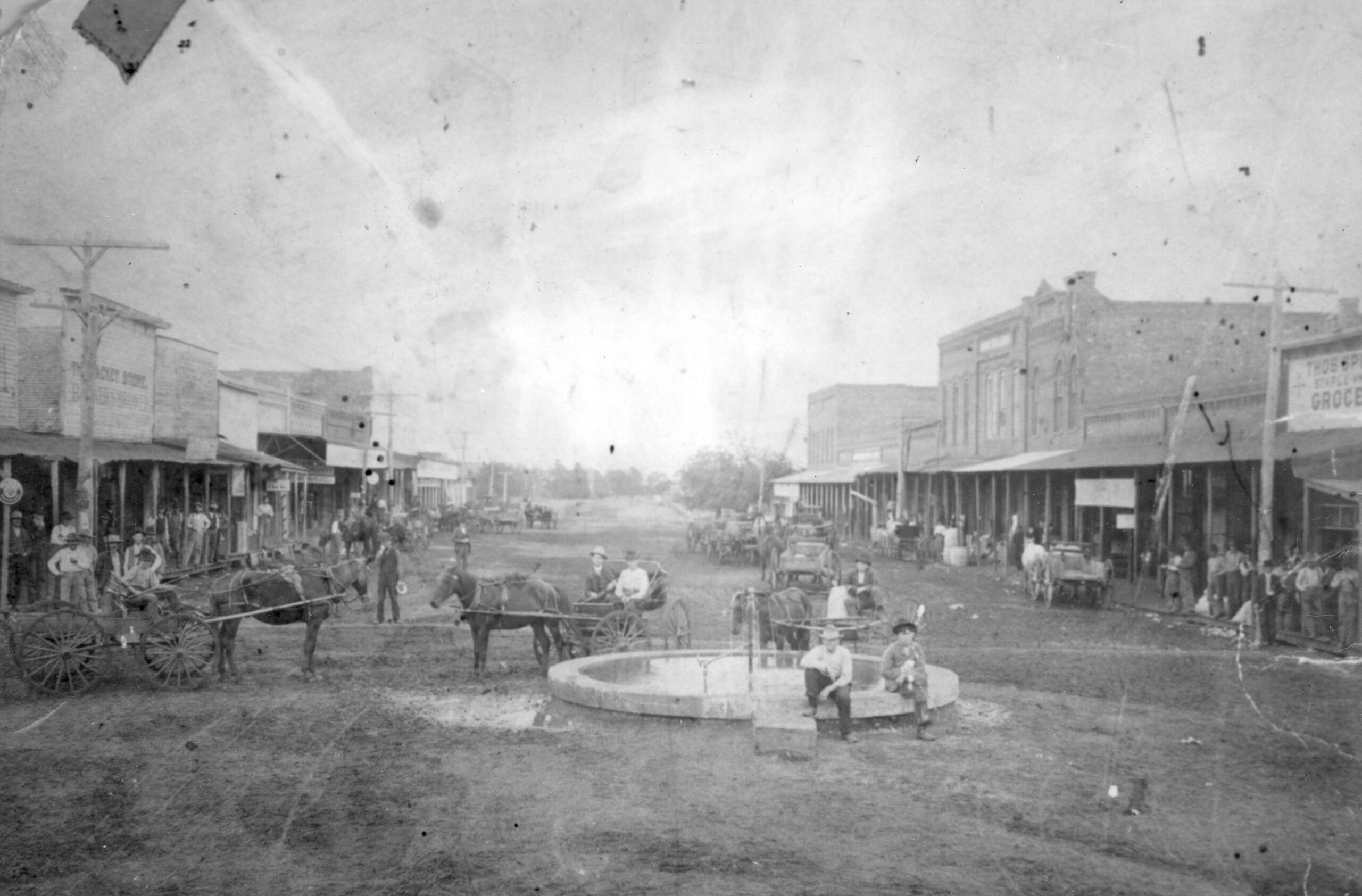
Founded in 1876, Arlington was still in its infancy fifteen years later—a small agricultural community with a population barely over 500. Cotton gins were plentiful and business was steady, as a small town was starting to form. Horses and buggies trotting along dirt roads were standard, as infrastructure and amenities—including local water sources—were still primitive.
In the early 1890s, merchant R. W. Collins saw the need for a public water well and initiated the project, raising funds through community support. Officials chose a site at Main and Center streets, the town’s most prominent intersection, right near the railroad tracks. Drilling began using a steam engine, and by 1892, the well was complete.
Unfortunately, the water was nearly undrinkable. People said it both tasted and smelled unappealing, so it was offered to horses and livestock instead. Some of them even refused it. Yet the water flowed abundantly and gallons spilled into the dirt streets. Folks began to notice a white powder residue as the water dried. It was then discovered that the water was heavily mineralized, explaining its poor taste. Nonetheless, it was later believed to have healing powers.
In the early 1900s, elixirs and health tonics were commonly touted in newspaper ads, shops, and pharmacies. Their medicinal value was often dubious at best, and many were more ploy than cure. However, some offered genuine health benefits, and Arlington’s mineral well water was generally believed to be more fact than fiction. Though as they say, your mileage may vary.
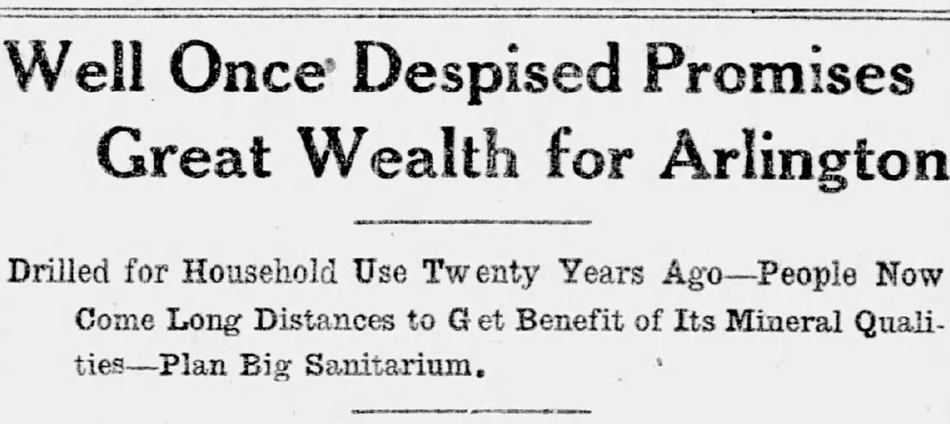
A 1909 newspaper featured a headline stating, “Well Once Despised Promises Great Wealth for Arlington,” and the town began to flourish around its mineral spring. With renewed interest, a new fountain was needed. Evolving past the original utilitarian structure, a decorative fountain was constructed around 1910 through efforts led by the Arlington Commercial Club. This fountain featured lion heads—still seen around Downtown Arlington today—likely chosen as symbols of strength and courage while reflecting popular architectural trends of the time. A new era had begun.
Around this time, Dr. J. D. Collins opened the Arlington Sanitarium on Center Street—a therapeutic resort for recovery, rest, and holistic wellness. It used (or as some newspapers noted, “exploited”) the mineral well water, which was being shipped across the Southwest in casks and jugs. Though skeptics remained, many were firm believers, and the water was respected enough to be piped directly into the sanitarium to treat indigestion, rheumatism, liver issues, and stomach problems.
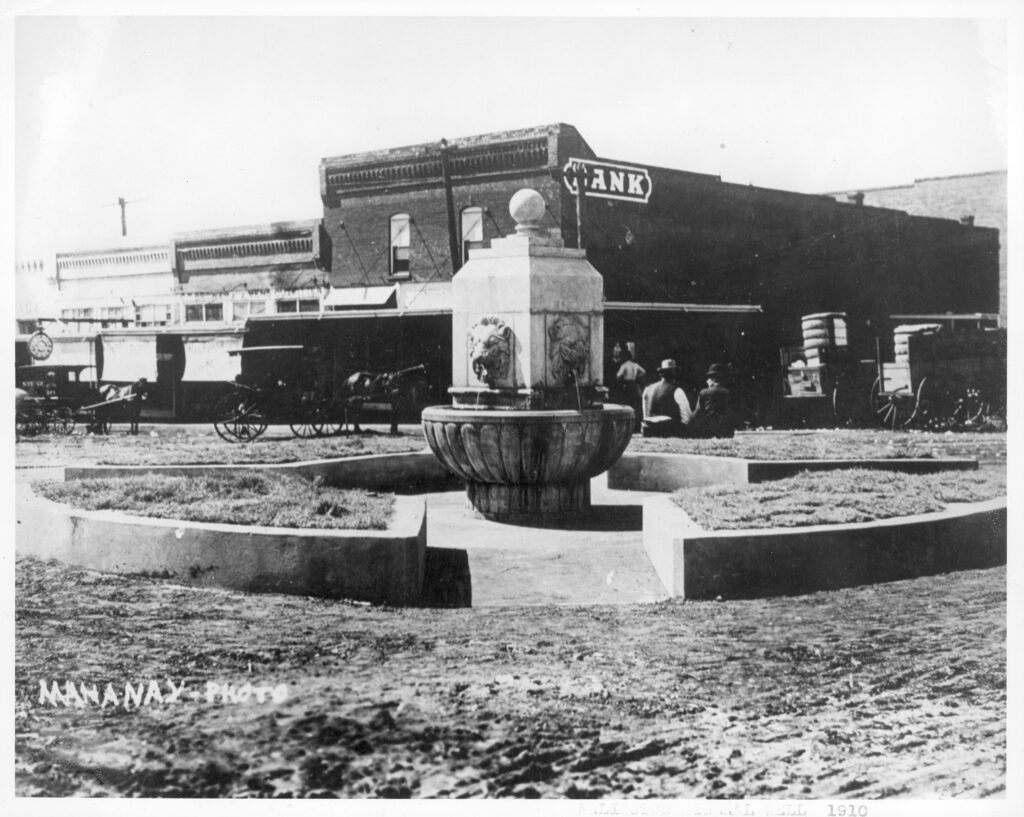
Through these efforts, Arlington’s mineral well became a city landmark and a core part of the town’s identity. Beyond serving as a gathering place for cotton sales, political rallies, and public events, it served as an early tourist draw. A popular pastime emerged known as “taking the waters,” similar to visiting a health spa today.
From these waters came Arlington Crystals, a popular product similar to Epsom salt. Well water was boiled down in large vats until the remaining minerals evaporated into a crystal-like powder. By drinking the diluted solution or soaking in a bath, users sought internal and external benefits—from improved digestion to healthier-looking skin. Packaged and shipped widely, the crystals further advanced Arlington’s association with its historic mineral well.
While such remedies were common at the time, they began to fade as federal regulations tightened. Nonetheless, Arlington’s mineral well continued to serve as a practical water source and focal point for the downtown area.
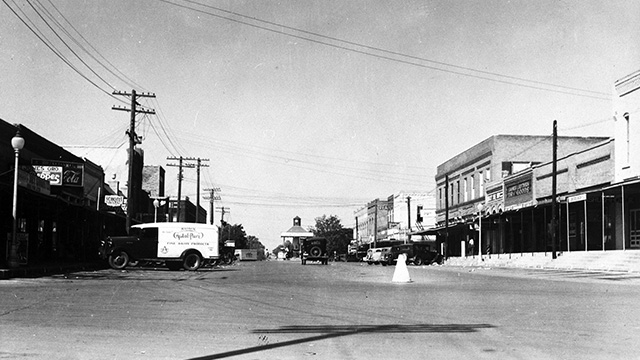
Arlington experienced explosive growth after World War II. Automobile traffic increased, and the mineral well—located in the street—became a traffic hazard. In 1951, the well was capped and covered to improve traffic flow. For nearly 60 years, the well had served as a city landmark, community focal point, and tourist draw. The water flowed through Arlington, both literally and metaphorically, becoming an enduring part of local identity. It was the end of an era.
Today, tributes remain throughout downtown if you know where to look. The most prominent is the Mineral Well Public Plaza, dedicated in 2023 and located near the site, featuring a version of the fountain paired with a clock tower. Another replica fountain is at the Vandergriff Town Center. Over at Knapp Heritage Park, the original stone watering trough is displayed. Nearby, the Wellspring on Main event venue pays homage in name, while the George W. Hawkes Downtown Library holds a preserved section of the original well structure in its Genealogy and Local History Room. Further, the iconic lion heads serve as a mascot across Downtown Arlington, used to define the district’s identity and boundaries.

While Arlington didn’t become as famous for its waters as the town of Mineral Wells to our west, the well was central to our community for nearly six decades. As a gathering space and early destination, it played a key role in shaping Downtown Arlington. Fittingly, Arlington’s Sister City—Bad Königshofen, Germany—is also a recognized spa town famous for its mineral springs, with “Bad” meaning bath or spa.
Perhaps for Arlington’s 150th anniversary, we should “take the waters” once more and revisit the well. How do you like your mineral water—over ice or with a mixer?
Jason S. Sullivan is a blogger exploring the past and present of Arlington. He has contributed local history articles to the City of Arlington’s website, Downtown Arlington’s blog, and Arlington Today magazine. As a board member, newsletter editor, and social media manager for the Arlington Historical Society, he is instrumental in sharing local history and preserving stories for future generations. In 2023, he received the Debbie Reynolds-Hazen Award, recognizing a younger individual for leadership in collecting and preserving Tarrant County’s history. Visit his blog at JasonSSullivan.com.