Early Settlers

(Prior to 1875)

Before Arlington existed, the land was home to Native peoples and early settlers who braved this Texas frontier.
1542
Indian Village near present-day Dottie Lynn Parkway
Painting depiction of Native American and Spanish Explorers.

Research has led some Texas historians to believe Spanish explorers made camp in an Indian village named Guasco on Village Creek near present-day Dottie Lynn Pkwy.
1838
Anglo-American efforts to settlement
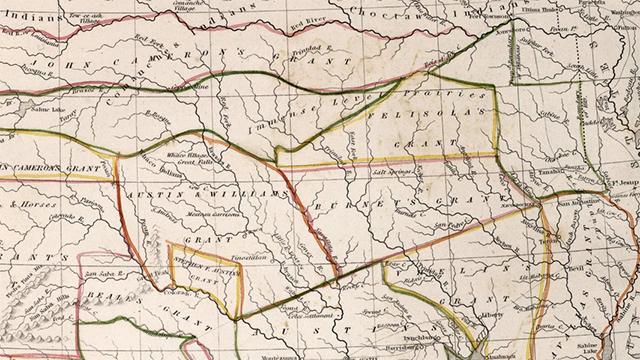
Map of Early Anglo-American Settlements in Texas
Map of Early Anglo-American Settlements in Texas. Photo Courtesy: Fielder Museum / Arlington Historical Society.

Robert Sloan and Nathaniel T. Journey lead an expedition into present-day Euless and Arlington that was recorded as one of the first Anglo-American efforts to open the area to settlement.
1841
Battle of Village Creek
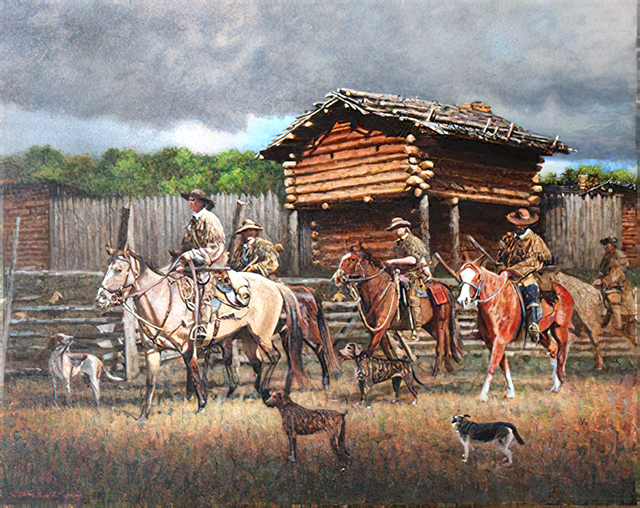
Depiction of Captain Jonathan Bird and crew creating Bird's Fort.
Depiction of Captain Jonathan Bird and crew creating Bird's Fort. Photo Courtesy: Fielder Museum / Arlington Historical Society.


General Edward H. Tarrant leads the Battle of Village Creek, killing many Native American people who called Village Creek their home. Captain Jonathan Bird creates Bird's Fort on the north side of present-day Arlington, Anglo-Americans' first attempt to settle in north Texas
1843
Treaty of Bird's Fort
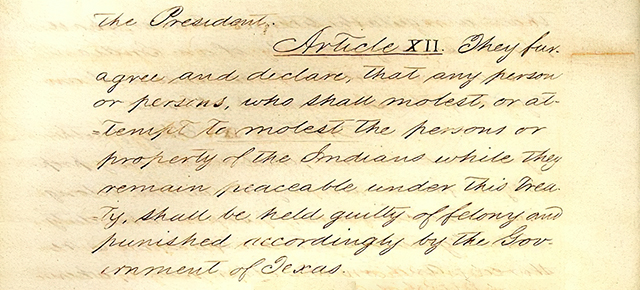
Portion of the handwritten Treaty of Bird's Fort.
Portion of the Treaty of Bird's Fort. Photo Courtesy: Fielder Museum / Arlington Historical Society.


Treaty of Bird's Fort, a peace treaty between Native Americans and the Republic of Texas opens the door to settlement in the entire region.

1848
Colonel Middleton Tate Johnson Arrives
Colonel Middleton Tate Johnson family pose for photo.


"Father of Tarrant County" Colonel Middleton Tate Johnson's Company of Texas Rangers is assigned to Kaufman Station, later known as Johnson Station.

1853
Patrick A. Watson Arrival
Log cabin on green grass.
P.A. Watson log house - Knapp Heritage Park - Arlington, TX. Photo Courtesy: Fielder Museum / Arlington Historical Society.


Patrick A. Watson and a group of settlers arrive and settle on land that now borders the present SH-360 (Watson Road).

1869
Andrew Shannon Hayter Arrives
Historical marker and bust of Reverend Andrew Hayter, Founders Plaza, Arlington, TX
Historical marker and bust of Reverend Andrew Hayter, Founders Plaza, Arlington, TX. Photo Courtesy: Fielder Museum / Arlington Historical Society.


"Father of Arlington" Reverend Andrew Shannon Hayter arrives and organizes the Good Hope Cumberland Presbyterian Church.

1870
Middleton Tate Johnson's Body Exhumed
Middleton Tate Johnson grave marker in Johnson Station Cemetery, Arlington, TX
Middleton Tate Johnson grave marker in Johnson Station Cemetery, Arlington, TX. Photo Courtesy: Fielder Museum / Arlington Historical Society.


Colonel Middleton Tate Johnson's body is exhumed from Texas State Cemetery and buried in a family cemetery on Arkansas Lane.

1871
Transcontinental Railroad
Transcontinental Railroad map
Transcontinental Railroad map. Photo Courtesy: Fielder Museum / Arlington Historical Society.


United States Congress approves a charter for a transcontinental railroad to run through what will later become Arlington, Texas.

First Church in Johnson Station

Elder John Quarles Burnett meets with 17 fellow Baptists and organizes the first church in Johnson Station - Johnson Station Baptist Church.

1873
Settlement founded near site of present-day city
Portion of plan for the town of Arlington with respect to the Texas & Pacific Railroad and Tarrant County pioneer land patents
Portion of plan for the town of Arlington with respect to the Texas & Pacific Railroad and Tarrant County pioneer land patents. Photo Courtesy: Fielder Museum / Arlington Historical Society.

A tiny settlement developed on the edge of Hayter's property.

1875
Petition for Post Office

Hayter petitioned for a post office in 1875. The post office was called Haytersville. Hayter had already founded two churches, a school, and a Masonic Lodge in the area.